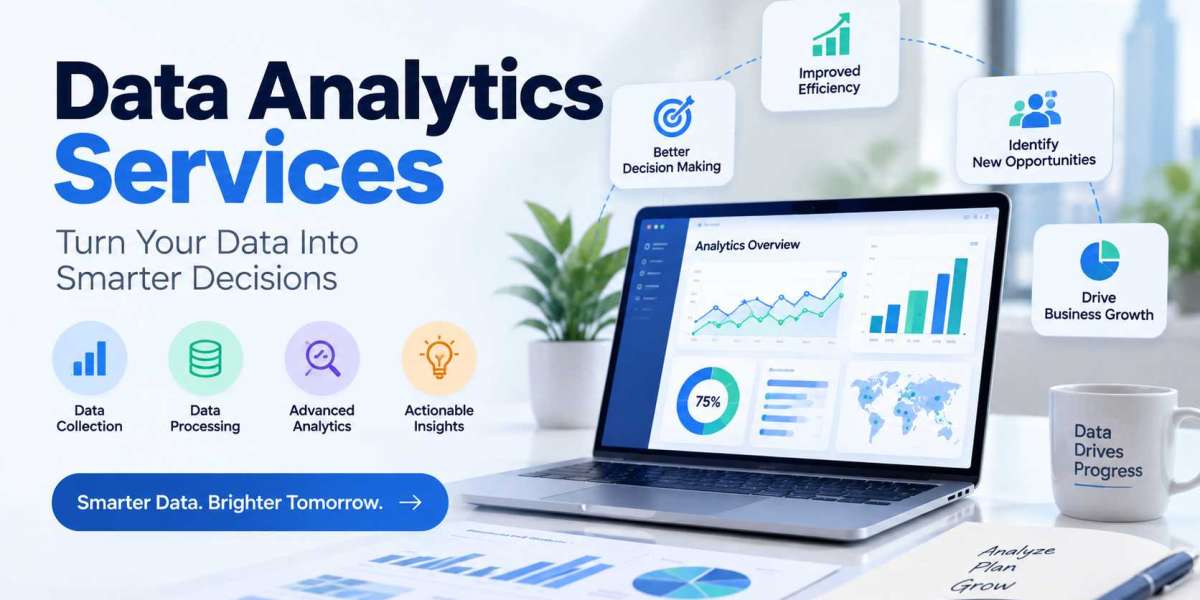

Businesses generate more data than ever—from customer interactions and sales transactions to website activity, operational systems, and financial records. However, having large amounts of information does not automatically lead to better decisions. Organizations need effective ways to collect, organize, analyze, and interpret that information.
This is where Data Analytics Services can play an important role. By turning raw information into meaningful insights, analytics can help organizations understand performance, identify patterns, improve operations, and make more informed strategic decisions.
What Are Data Analytics Services?
Data analytics involves examining datasets to identify useful patterns, trends, relationships, and opportunities. Data Analytics Services typically cover a range of activities, including data collection, preparation, analysis, visualization, reporting, and analytics strategy.
Rather than relying entirely on assumptions or isolated reports, businesses can use analytics to develop a clearer understanding of what is happening across different areas of the organization.
For example, an online retailer might analyze purchasing behavior to identify popular products, while a logistics company could examine delivery data to identify recurring delays.
Why Data Analytics Matters for Modern Businesses
The value of Data Analytics extends beyond producing charts and dashboards. When implemented properly, analytics can support decisions across marketing, finance, sales, customer service, supply chains, and product development.
Better Decision-Making
Analytics can provide decision-makers with evidence that supports business planning. Historical and real-time data can reveal patterns that may not be obvious through manual analysis.
Improved Operational Efficiency
Organizations can examine processes to identify bottlenecks, unnecessary costs, and areas where resources are being underused. These insights can help teams improve workflows and allocate resources more effectively.
Deeper Customer Understanding
Customer data can reveal purchasing patterns, engagement behavior, preferences, and potential areas of dissatisfaction. Businesses can use these insights to improve customer experiences and develop more relevant strategies.
More Accurate Performance Tracking
Analytics dashboards can bring key metrics into one place, allowing teams to monitor performance and identify changes more quickly.
What Do Data Analytics Services Include?
The scope of analytics can vary depending on an organization's requirements. However, several capabilities are commonly involved.
Data Collection and Preparation
Raw data often comes from multiple sources and may contain duplicate, incomplete, or inconsistent records. Before analysis, data needs to be cleaned, structured, and prepared.
This stage is important because inaccurate or poorly organized data can lead to unreliable conclusions.
Data Visualization and Reporting
Visual dashboards can make complex information easier to understand. Charts, graphs, and interactive reports allow users to identify trends and compare performance without manually reviewing large datasets.
Predictive and Advanced Analytics
Businesses can also use historical information to identify potential future outcomes. Predictive analytics can support applications such as demand forecasting, customer behavior analysis, risk assessment, and inventory planning.
Choosing Data Analytics Services for Businesses
Organizations evaluating data analytics services for businesses should begin with their actual objectives rather than selecting technologies first.
1. Define the Business Problem
Start by identifying what the organization wants to improve. This could involve reducing operational costs, understanding customer behavior, improving forecasting, or measuring marketing performance.
A clearly defined objective makes it easier to determine what data and analytical methods are required.
2. Evaluate Data Quality
Before investing heavily in analytics, businesses should assess whether their existing data is accurate, accessible, and sufficiently complete.
Poor-quality data can limit the value of even sophisticated analytics platforms.
3. Consider Scalability
Analytics requirements often grow as businesses expand. The chosen architecture should be capable of handling increasing data volumes, additional sources, and more users without creating unnecessary complexity.
4. Establish Security and Governance
Data analytics may involve sensitive customer, financial, or operational information. Organizations should establish appropriate access controls, security measures, privacy practices, and governance policies.
The Role of Cloud Analytics
Cloud technology has changed how organizations manage and analyze information. cloud data analytics services can provide scalable infrastructure for storing and processing large datasets without requiring businesses to maintain all computing resources on-site.
Cloud-based architectures can also make it easier to integrate data from different applications and provide analytics capabilities to distributed teams.
However, cloud adoption still requires careful planning. Organizations should consider data security, compliance requirements, integration needs, performance, and ongoing infrastructure costs.
How Data Analytics Solutions Create Long-Term Value
Modern data analytics solutions are most valuable when they become part of everyday decision-making rather than remaining isolated technical projects.
For example, a business could combine sales, customer, and operational data into a centralized analytics environment. Teams could then use dashboards to monitor important metrics while analysts investigate deeper trends.
This creates a continuous cycle: collect data, analyze it, identify insights, take action, and measure the results.
Companies such as CodeCones also approach analytics from this broader perspective, combining data engineering, analytics, business intelligence, and modern technology approaches to help organizations turn complex data into usable business insights.
Common Mistakes to Avoid
Businesses can encounter several challenges when implementing analytics.
One common mistake is collecting excessive amounts of data without defining how it will be used. Another is focusing too heavily on dashboards while overlooking data quality and governance.
Organizations may also choose complex technologies before understanding their actual requirements.
A practical approach is to start with a specific business objective, establish reliable data foundations, measure results, and expand analytics capabilities gradually.
Conclusion
Data analytics has become an important part of modern business strategy. From improving operational efficiency to understanding customers and supporting forecasting, effective analytics can help organizations make decisions based on meaningful evidence rather than assumptions.
The most successful approach is not simply about adopting new tools. Businesses need reliable data, clear objectives, appropriate technology, strong governance, and teams capable of translating analytical findings into practical actions.
Organizations exploring their next analytics initiative can begin by identifying a specific business challenge and assessing the data already available. From there, they can evaluate suitable technologies and Data Analytics Services that align with their long-term objectives.