
Choosing to seek professional support is a monumental step toward self-improvement, yet many find themselves confused by the terminology used in the mental health field. While the terms are often used interchangeably in casual conversation, there are distinct clinical differences between the two. Whether you are struggling with a specific family problem or dealing with deep-rooted emotional patterns, understanding these nuances ensures you find the right fit for your journey.
Understanding the Divide: Counselling vs. Psychotherapy
The primary confusion lies in the fact that both professions share a common goal: improving a person's mental well-being and quality of life. Both involve a collaborative relationship between a trained professional and a client, conducted in a safe, confidential environment. However, the "depth" of the work and the "time orientation" usually define which path is being taken.
1. Counselling: The Solution-Oriented Approach
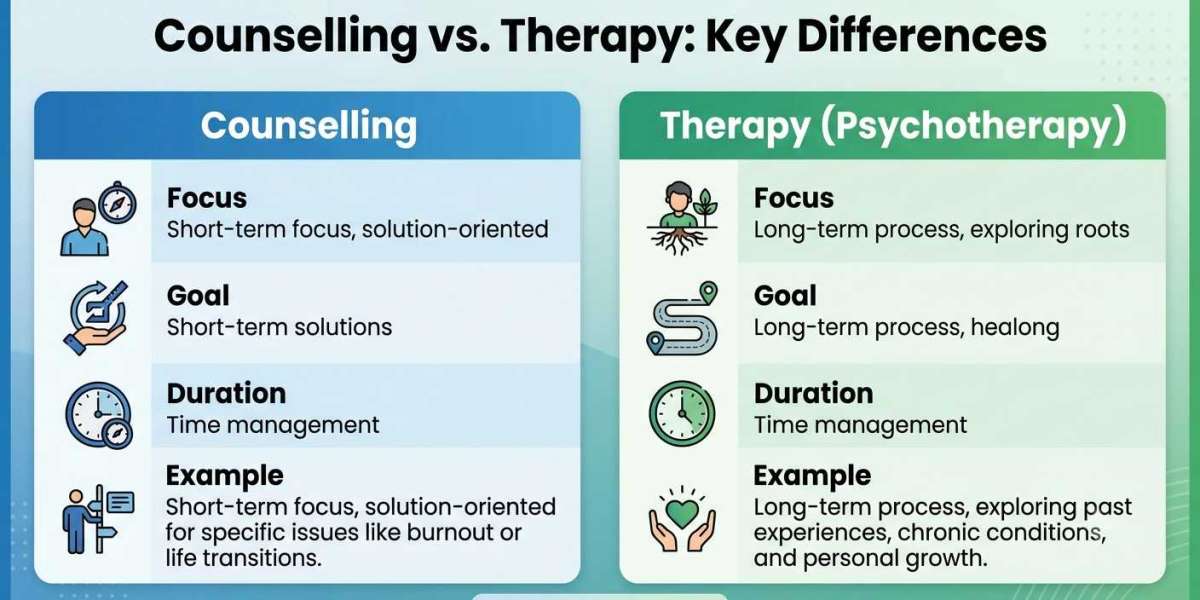
Counselling is generally defined as a short-term intervention that focuses on specific, present-day issues. It is often described as "talk therapy" that helps a person process a particular life transition or a situational crisis. The focus is on behavior management and developing immediate coping strategies.
Focus on the "Now"
A counsellor works with you to resolve a specific roadblock. For instance, if you are experiencing burnout due to high-pressure demands in the workplace, a counsellor will help you develop time and stress management techniques. The goal is not necessarily to uncover your childhood history, but to give you the tools to function better in your current environment.
Common Areas for Counselling:
- Career Issues: Navigating a job loss, a promotion, or a career pivot.
- Couple Conflicts: Resolving a specific disagreement or communication breakdown in a relationship.
- Grief: Processing the immediate aftermath of a loss.
- Low Motivation: Overcoming a temporary slump or a cycle of procrastination to reach a specific target.
In these scenarios, the professional helps you with goal setting, providing a structured roadmap to move from a state of feeling stuck to a state of action.
2. Therapy: The Deep-Dive into Identity
Psychotherapy (often simply called therapy) is usually a longer-term process that looks at the "whole person" rather than just a single problem. It aims to uncover the root causes of persistent emotional patterns, often tracing them back to early life experiences, family dynamics, or even subconscious beliefs.
Focus on the "Why"
While a counsellor primarily explores "How do I navigate this situation right now?", a therapist investigates the internal machinery behind your behavior, asking, "What is the origin of this recurring cycle in my life?" For instance, when addressing generalized anxiety disorder, a professional does not merely offer tools for immediate distress tolerance. Instead, they work to deconstruct the long-standing "mental blueprints" and skewed cognitive habits that trap your nervous system in a cycle of hyper-vigilance. By exposing these invisible catalysts, therapy allows you to shift from a state of constant survival to one where you can dissolve the source of anxiety at its core.
Addressing Chronic Conditions
Therapy is the appropriate route for chronic mental health conditions that require long-term management and deep "re-wiring" of the brain. This includes treating clinical depression or providing the complex, multi-layered support needed for someone living with schizophrenia. It is also the preferred method for dealing with a long-standing addiction, where the substance use is often a symptom of much deeper emotional pain or trauma.
3. Key Differences at a Glance
To help you decide which path is right for your current state, consider these three categories:
Duration and Frequency
- Counselling is typically brief, lasting anywhere from six sessions to six months. It is often weekly or even bi-weekly.
- Therapy can be an ongoing journey that lasts for years. It focuses on fundamental personality change and long-term resilience.
The Role of the Past
- In counselling, the past is acknowledged but rarely dwelt upon. The focus stays on current interpersonal problem areas.
- In therapy, the past is a primary tool for understanding the present. You might spend months exploring how your upbringing influenced your current self esteem.
Skill Building vs. Healing
- Counselling focuses on emotion control and practical "life skills."
- Therapy focuses on "healing" the wounded parts of the self and resolving an identity crisis.
4. When the Lines Blur
It is important to note that many modern professionals are trained in both areas. A best counselling psychologist online might start with a client to solve a specific family problem (counselling) but eventually transition into deeper work if they realize the conflict is rooted in an old trauma (therapy).
Similarly, many people seek therapy for a specific crisis, like a sudden burst of anger, only to find that the process of exploring that anger leads to a profound sense of loneliness that has been present since childhood.
Conclusion: Finding Your Path to Peace
Whether you choose counselling or therapy, the most important factor is the "therapeutic alliance"—the bond of trust between you and your provider. If you are struggling with a situational hurdle, counselling can provide the quick intervention you need to regain your footing. If you feel that your struggles are part of a deeper, recurring cycle that affects your core sense of self, therapy offers the depth required for a total reset.
If you find yourself stuck in a loop of negative thinking, or if the weight of your emotions is making it difficult to function, don't wait for the crisis to deepen. Finding the best therapist online or a best counselling psychologist online can give you the objective perspective needed to clear the fog.
The journey toward mental health is not a sign of weakness, but a profound act of courage. To bridge the gap between where you are and where you want to be, you can access evidence-based support from the best psychologist online through TalktoAngel. We offer s